 Image 1 of 3
 Image 2 of 3
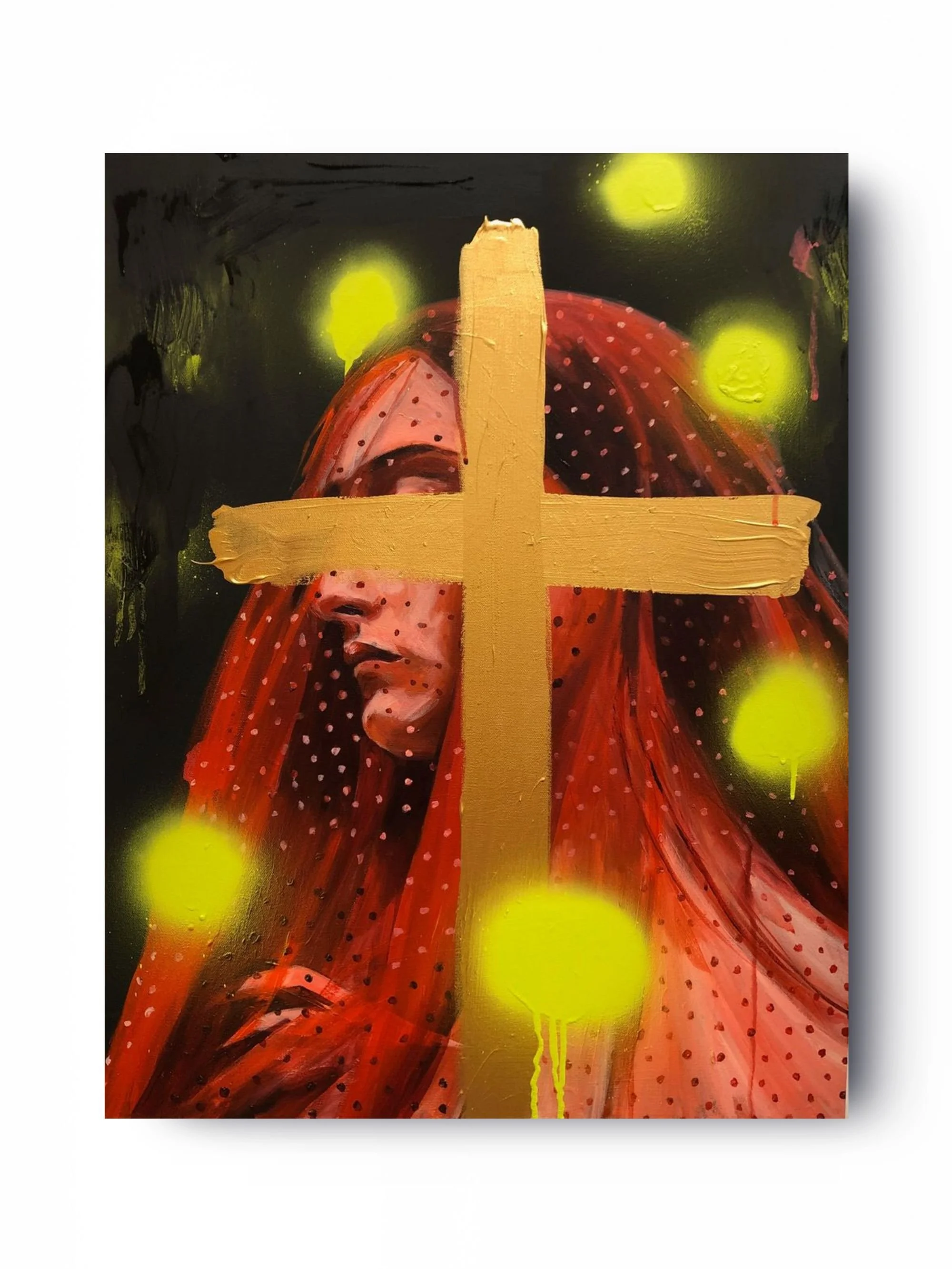 Image 3 of 3
Acrylic and Spray Paint on Canvas | 22×28 inches | 2019 | Divine Feminine
She is looking at you through the cross.
Not around it. Not beneath it. Through it — her gaze steady, her expression carrying the particular quality of someone who has been misrepresented for two thousand years and has developed, in that time, a profound and unshakeable patience. The gold cross is painted over her face with the weight of an institution, the authority of a decree, the particular violence of something imposed rather than chosen. And yet she remains. Completely, stubbornly, luminously present behind it.
This is Lourdes. And it is a painting about what was taken.
The history is not ancient — it is ongoing. Mary Magdalene, the woman who stood at the foot of the cross when the male disciples had fled, who arrived first at the empty tomb, who was chosen to be the first witness of the resurrection and therefore the first evangelist in Christian history — the most advanced disciple, the one to whom the most sacred knowledge was first entrusted — was formally declared a prostitute by Pope Gregory I in 591 AD. Not because there was evidence. Because the authority of a woman of that stature, in that proximity to the divine, in that position of spiritual leadership, was intolerable to the institution that was building itself in the centuries after her death.
The declaration held for nearly fourteen hundred years. The Vatican only officially reversed it in 1969.
This is one story. It stands for thousands. The women healers whose knowledge of plants and bodies and the cycles of the natural world — knowledge accumulated over generations, passed mother to daughter, the original medicine — was reframed as witchcraft and punished accordingly. The mystics whose direct experience of the divine, unmediated by male clergy, was evidence of possession rather than grace. The prophets, the seers, the women who simply knew things — who had the particular intuitive intelligence that the Divine Feminine series has always been made to celebrate — and who paid for that knowing with their lives, their reputations, their freedom, their place in the story that was subsequently written about them.
The thin line. The terrible, arbitrary, institutionally maintained thin line between saint and witch, between veneration and condemnation, between Mary of Nazareth and Mary Magdalene as the church chose to construct her. The same woman, the same gift, the same connection to something larger than the institution — and the institution deciding, in each case, which story to tell.
The neon yellow orbs float through the darkness like the things that were never successfully suppressed — the knowledge, the intuition, the light that institutions can overlay with gold crosses but cannot extinguish. They glow with the particular persistence of truth that has been buried and keeps surfacing anyway. They are the fireflies of the feminine divine — small, bright, entirely unconcerned with what the institution decided about them.
The red veil. The gold cross. The steady gaze. The unextinguished light.
She is still here. She was always going to be still here.
✦ Original, one-of-a-kind painting ✦ Acrylic and spray paint on canvas ✦ 22 × 28 inches ✦ Created 2019 ✦ Part of the Divine Feminine series ✦ Free worldwide shipping
Two thousand years of misrepresentation. One steady gaze. Still here.
Acrylic and Spray Paint on Canvas | 22×28 inches | 2019 | Divine Feminine
She is looking at you through the cross.
Not around it. Not beneath it. Through it — her gaze steady, her expression carrying the particular quality of someone who has been misrepresented for two thousand years and has developed, in that time, a profound and unshakeable patience. The gold cross is painted over her face with the weight of an institution, the authority of a decree, the particular violence of something imposed rather than chosen. And yet she remains. Completely, stubbornly, luminously present behind it.
This is Lourdes. And it is a painting about what was taken.
The history is not ancient — it is ongoing. Mary Magdalene, the woman who stood at the foot of the cross when the male disciples had fled, who arrived first at the empty tomb, who was chosen to be the first witness of the resurrection and therefore the first evangelist in Christian history — the most advanced disciple, the one to whom the most sacred knowledge was first entrusted — was formally declared a prostitute by Pope Gregory I in 591 AD. Not because there was evidence. Because the authority of a woman of that stature, in that proximity to the divine, in that position of spiritual leadership, was intolerable to the institution that was building itself in the centuries after her death.
The declaration held for nearly fourteen hundred years. The Vatican only officially reversed it in 1969.
This is one story. It stands for thousands. The women healers whose knowledge of plants and bodies and the cycles of the natural world — knowledge accumulated over generations, passed mother to daughter, the original medicine — was reframed as witchcraft and punished accordingly. The mystics whose direct experience of the divine, unmediated by male clergy, was evidence of possession rather than grace. The prophets, the seers, the women who simply knew things — who had the particular intuitive intelligence that the Divine Feminine series has always been made to celebrate — and who paid for that knowing with their lives, their reputations, their freedom, their place in the story that was subsequently written about them.
The thin line. The terrible, arbitrary, institutionally maintained thin line between saint and witch, between veneration and condemnation, between Mary of Nazareth and Mary Magdalene as the church chose to construct her. The same woman, the same gift, the same connection to something larger than the institution — and the institution deciding, in each case, which story to tell.
The neon yellow orbs float through the darkness like the things that were never successfully suppressed — the knowledge, the intuition, the light that institutions can overlay with gold crosses but cannot extinguish. They glow with the particular persistence of truth that has been buried and keeps surfacing anyway. They are the fireflies of the feminine divine — small, bright, entirely unconcerned with what the institution decided about them.
The red veil. The gold cross. The steady gaze. The unextinguished light.
She is still here. She was always going to be still here.
✦ Original, one-of-a-kind painting ✦ Acrylic and spray paint on canvas ✦ 22 × 28 inches ✦ Created 2019 ✦ Part of the Divine Feminine series ✦ Free worldwide shipping
Two thousand years of misrepresentation. One steady gaze. Still here.